Against the Extension of the Copyright Term on Non-Artistic Photographs in Italy
The LWP's Blog · Categories: Copyright
Against the Extension of the Copyright Term on Non-Artistic Photographs in Italy
By Michele Lavazza · 26 October 2025
An enlightened provision in Italian copyright law, granting non-artistic photographs shorter copyright protection than artistic ones, is now threatened by yet another phenomenon of public domain erosion. The change, currently being discussed in the lower house of the Italian parliament, is opposed by the free-culture movement and by public domain advocates. The Ludwig Wittgenstein Project joins their protest.
Every country has its copyright legislation, and, although some attempts at harmonisation have been made, for example in the European Union, these legislations differ considerably from one another.
If one wanted to give a few examples of this variety, one could do so by showing how legislations—and even specific rules and provisions within the legislation of an individual country—can be arranged on a hypothetical “openness” spectrum. In other words, one could attempt to classify them as “relatively closed” or “relatively open”.
The overarching goal of all copyright systems is to balance the interest of the rights holders (who want to control creative works and profit from their distribution) and that of the public (who wants to access creative works and use them). Some systems or some features of a system might be called “relatively closed” insofar as they privilege the interest of the right holders; others might be called “relatively open” insofar as they privilege the interest of the public.
Thus, the copyright legislation of France may be called “more closed” than that of China insofar as in France the copyright term is 70 years after the death of the author (post mortem auctoris or PMA), whereas in China it is only 50 years PMA.
| China | France |
|---|---|
| 50 years PMA | 70 years PMA |
At the same time, the copyright legislation of the United States, which generally speaking is “quite closed”, may be called “unusually open” insofar as it includes a rule whereby all works “prepared by an officer or employee of the US Government as part of that person’s official duties” are not copyrighted at all. The rationale for this is that such works should immediately belong to the public, who commissioned and sponsored them in the first place.
| United States | Typical |
|---|---|
| None | 50 to 70 years PMA (but may vary) |
In a similar way, Italy has a rather unique and “very open” rule which concerns photographs of a non-artistic nature. In Italy, the standard copyright term for artistic photos and other creative works such as writings, music, drawings and paintings, etc., is 70 years PMA—the same as in the rest of the EU. According to Article 92 of Law No. 633 of 22 April 1941, however, those photographs which do not have a distinctively creative or original nature, including “pictures of people or views, elements or facts of natural and social life” (“immagini di persone o di aspetti, elementi o fatti della vita naturale e sociale”), are only copyrighted for 20 years after their creation instead of 70 years PMA.
This rule is understood to cover what we also call “simple” photographs or “immagini di cronaca”, that is, for example, those matter-of-fact photos which often accompany a news story on a paper or website. It has allowed educational resources of every kind, from history textbooks to Wikipedia, to freely reproduce images that are unassuming in form, but highly meaningful in content; and, by doing so, it has made it possible for them to illustrate our recent history and bring it back to life without taking on the financial burden and bureaucratic hurdles that go hand-in-hand with having to secure permission to reproduce a copyrighted image.
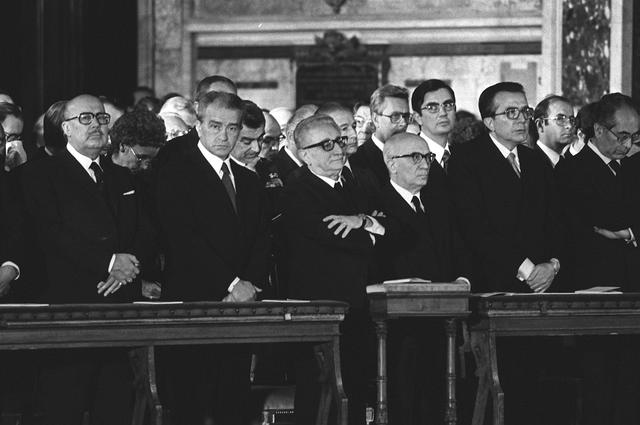
It is not always easy to decide whether an individual photo should count as artistic or not, but, to understand the distinction, we can look at a few examples. The following were uploaded to the Italian-language Wikipedia as non-artistic photos:
-
 Memorial service for Aldo Moro, former prime minister of Italy, 13 May 1978
 -
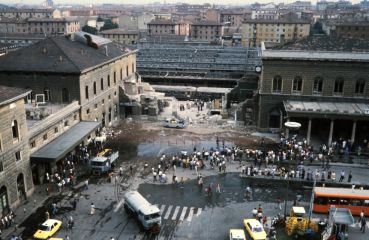 Aftermath of the neo-fascist terror attack at the Central Station of Bologna, 2 August 1980
 -
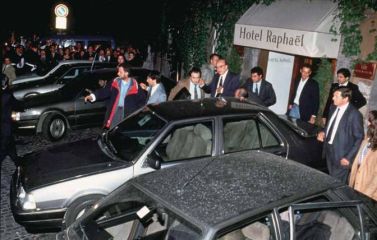 A crowd throws coins at former prime minister of Italy Bettino Craxi after his admission of widespread corruption, 30 April 1993


It is clear, I think, why I call this an enlightened piece of legislation: in a global landscape of overreaching copyright laws, where an unbalanced understanding of the relationship between the rights holders’ interest and the public’s disproportionately favours the former, this Article 92 does its job of protecting the latter. And it does so by acknowledging a substantial difference between two kinds of photographs which are unalike not only in their artistic merit, but also in their socio-economical lifecycle:
- An artistic photograph, as such, aims to be timeless: therefore, even if 70 years PMA is still a ludicrously long time, it makes sense to imagine that long-term copyright protection would be in the author’s interest without unduly harming the public’s;
- A non-artistic photograph, which typically has a documentary value, either makes money for its author in the first few weeks since it’s taken, or it never does: therefore, even if 20 years is also a ludicrously long time, it makes sense to think that short-term copyright protection would not harm the author’s interest while safeguarding the public’s.
Now a proposal by a group of right-wing deputies led by Alessandro Amorese aims to extend the copyright term on non-artistic photographs to 70 years after their creation. The new proposed law, currently being discussed by a commission of the Italian Chamber of Deputies, retains the difference between non-artistic and artistic photos, but it extends the copyright term on the former by more than three times.
| Current | Proposed | |
|---|---|---|
| Artistic photos | 70 years PMA | 70 years PMA |
| Non-artistic photos | 20 years from creation | 70 years from creation |
The stated reason for the change is as follows (my translation from Italian): “In a society where widely accessible technology has brought photographic tools (e.g. multimedia mobile phones) within everyone's reach, it becomes imperative to reaffirm the photographer's authorial value, with a particular focus on the elimination of the distinction between a simple photograph and a photographic work [opera fotografica], as set out in Law No. 633 of 22 April 1941. This distinction no longer reflects the complexity of the contemporary photographer's work, which combines technical skills, creative sensitivity and innovative post-production processes. The centrality of the photographer as author must be recognised through the protection of the entire creative process, from the choice of photographic parameters to the post-production stages.”
It is astonishing how this makes utterly no sense. It is of course true that cameras are more widespread now than they have ever been. But this, if anything, reduces the degree of creativity involved in shooting the vast majority of the photos that smartphone owners typically shoot. The very ubiquity of cameras causes us to use them mindlessly most of the time. It has always been perfectly possible to shoot a photo that legally counts as artistic with a cheap camera or a smartphone, and of course it still is; as a trend, however, truly pocket cameras have increased the divide between non-artistic and artistic photographs, because, while the technical skill and creative commitment involved with the latter could be considered unaffected by the spread and evolution of smartphones, those involved with the former have been slashed.
Thus, if the reason for extending the copyright term on non-artistic photos is to “reaffirm the photographer’s authorial value”, but the non-artistic photographer is now putting even less brains and heart into their pictures than they did before, then that reason is a bad reason. They say they want to protect the value of something that has never been this close to being worthless.
It should also be noted that, although the introductory remarks I quoted talk about cancelling the distinction between artistic and non-artistic photos, the document goes on to propose that that distinction be retained, and that the copyright term on non-artistic photos (now called “photographs” as opposed to “photographic works”) simply be extended from 20 to 70 years after creation. The argument is not, then, that the distinction is no longer valid; it is that, even where it is scarcer, i.e., when the photo does not have an artistic quality, “the photographer’s authorial value” still deserves to be protected for a literal lifetime.
The way our capitalist-friendly government operates, whenever the choice is between the public interest and private property, private property prevails.
If the law passed, moreover, the benefit for photographers would be negligible. In the case of non-artistic photographs, these are either amateurs (and then they lack practical ways of getting paid when their photos are used) or they publish their pictures anonymously (and then it would be impossible to track them down and pay them 20+ years after the creation of their photo). If any kind of benefit were to come out of this at all, it would only be the publisher’s benefit. The overall outcome would then be the impoverishment of our shared visual memory and, perhaps, the enrichment of those big actors in the media business who hire photographers, typically pay them once, and then try to profit off of their work for decades.
Wikimedia Italia, the local chapter of the US-based foundation which keeps the infrastructure of Wikipedia running, estimates that, if it passed, the new law would cause 80.000 photos to be removed from Wikimedia’s repositories of public-domain and freely-licenced images (the Italian-language Wikipedia, Wikimedia Commons); those 80.000 photos provide visual context for 140.000 articles which are viewed by tens of millions of people monthly. And, of course, the new law would also prevent countless other pictures from being uploaded to the Wikimedia sites and other websites in the near future.
Without the possibility for them to be lawfully posted online, simple but precious images that document everyday life and historical events also risk being lost and forgotten; and, when found, they risk being lost again because it’s impossible to find the author or their heirs or because it’s too expensive to pay the publishers.
Making it harder to freely share old non-artistic photos harms culture and knowledge. Those of us who, for the love of culture and knowledge as shared goods, believe in the public domain as a necessary counterweight to copyright—we strenuously oppose this reform. The public’s interest in freely accessing culture should not be sacrificed to profit more than it already has been.
The Ludwig Wittgenstein Project joins major actors in the Italian cultural landscape (Wikimedia Italia, ICOM Italia, ANAI, AIB and Creative Commons Italia) in protesting against this initiative: keep Article 92 as it is, stop eroding the public domain, and let us share in the media that shapes our visual understanding of recent history.
About the author

More from the LWP's blog
Happy 2026 from the Ludwig Wittgenstein Project!
Cover image: "Ludwig Wittgenstein Skjolden Norge 2024" by Vadim Chuprina, CC BY-SA 4.0


